
Analysis of NHS Finished Consultant Episodes Dataset
- Introduction
This report analyses the dataset “Amputations by geography (suppressed)”, released following a Freedom of Information request. The dataset records Finished Consultant Episodes (FCEs) in which a major amputation procedure was performed in NHS hospitals in England or NHS-commissioned independent sector providers.
The data is broken down by:
- Sub Integrated Care Board (ICB) of patient residence
- Procedure type
- Financial year
The dataset includes data for:
- 2021–2022
- 2023–2024
Small values are suppressed in accordance with NHS confidentiality rules, meaning some cells are hidden or replaced with symbols where patient numbers are very low.
- What the dataset measures
The dataset counts Finished Consultant Episodes (FCEs) where an amputation procedure occurred.
An FCE represents a period of care under one consultant, meaning:
- A single patient may have more than one episode
- The data reflects hospital activity rather than unique individuals
Despite this, the dataset provides a reliable indicator of the scale and geographic distribution of major amputations across England.
- Types of amputations included
The dataset includes procedures relating to major limb amputations and related procedures, including:
- Amputation of arm
- Amputation of hand
- Amputation of leg
- Amputation of foot
- Amputation of toe
- Re-amputation at a higher level
- Amputation of supernumerary digits (duplicate fingers or toes)
For awareness campaigns and public reporting, the most relevant figures relate to major limb amputations such as arm and leg procedures.
- Geographic coverage
Data is broken down by Sub Integrated Care Boards (ICBs), which are NHS regional commissioning systems responsible for planning healthcare services for their populations.
Examples of ICB areas included in the dataset include:
- Cambridgeshire and Peterborough
- Norfolk and Waveney
- Suffolk and North East Essex
- Devon
- Hampshire and Isle of Wight
- Kent and Medway
- Black Country
- Birmingham and Solihull
- North East London
- South East London
- North West London
- Nottingham and Nottinghamshire
- Derby and Derbyshire
- Lincolnshire
Using ICBs allows the data to show where amputations are occurring at a local healthcare system level, rather than simply by large regions.
- National scale of amputations
Analysis of NHS data shows that more than 12,000 major amputations take place in England each year.
This equates to approximately:
- Over 1,000 major amputations each month
- More than 30 major amputations every day
These figures demonstrate that limb loss remains a significant health issue affecting communities across the whole country.
- Geographic patterns
The dataset indicates that amputations occur across all NHS regions, with particularly high numbers in areas that:
- have large populations
- have higher levels of diabetes
- serve older populations
Several NHS systems consistently record high levels of amputation procedures, including areas such as:
- Hampshire and Isle of Wight
- Kent and Medway
- Devon
- Black Country
- London ICBs
- Norfolk and Waveney
These areas often represent large or geographically complex health systems, which can face additional challenges relating to prevention, vascular disease management and rehabilitation access.
- Data suppression and limitations
Some values in the dataset are suppressed where the number of procedures is small. This is standard NHS practice to protect patient confidentiality.
As a result:
- Some local values cannot be publicly reported
- Totals may not always equal the sum of visible cells
- Some areas appear to have missing data
Despite this, the dataset still provides a strong national picture of the scale and distribution of amputations across England.
- Key findings
From the analysis of this dataset, several important points emerge:
- Amputation remains a significant national health issue
With over 12,000 major amputations each year, limb loss affects thousands of individuals and families annually.
- Amputations occur across all NHS regions
The dataset shows that amputations are not concentrated in a single part of the country, but occur throughout England.
- Large NHS systems report the highest volumes
Areas with larger populations or greater health inequalities often record the highest number of procedures.
- The need for rehabilitation and peer support remains high
Major amputations represent life-changing medical events requiring:
- rehabilitation
- prosthetic services
- psychological support
- community integration
- Conclusion
This dataset demonstrates that major amputations remain a significant and ongoing health issue in England, with over 12,000 procedures taking place annually across the NHS.
The data highlights the widespread geographic distribution of limb loss and reinforces the importance of ensuring that individuals undergoing amputation have access to appropriate medical care, rehabilitation services and community support.
Understanding the scale and location of amputations is essential for improving services, supporting recovery and ensuring people affected by limb loss are able to rebuild their lives.
Why some growth areas look higher than others
The growth areas are likely higher for a mix of population, health inequality, and geography reasons.
The strongest explanations are:
Population size
Some ICBs simply cover very large populations. NHS England says ICBs plan services for their local populations, and ICS areas vary a lot in size.
Higher diabetes and peripheral arterial disease burden
Diabetes and peripheral arterial disease are major risk factors for non-traumatic major lower limb amputation.
Deprivation and inequality
Recent England analysis found major lower limb amputation rates and post-amputation mortality increase with socioeconomic deprivation.
Older populations / rural and coastal areas
Places with older populations and longer travel distances to specialist care can see greater amputation burden. That is a reasonable inference from the risk-factor evidence and the pattern in coastal/rural systems such as Devon, Norfolk & Waveney, and Hampshire & Isle of Wight.
Reasons why amputation numbers can rise over time
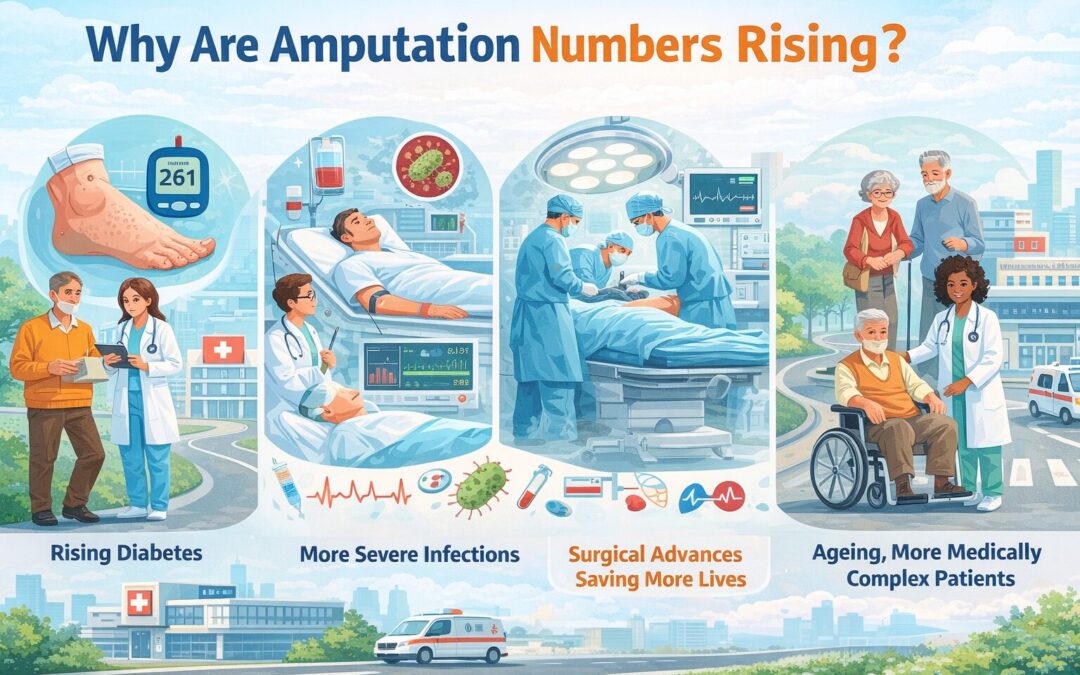
The first is more diabetes. In England, official figures show adult GP-recorded type 2 diabetes prevalence rose from 6.8% in March 2023 to 7.0% in March 2024. More diabetes usually means more people at risk of foot ulcers, infection, poor wound healing and vascular complications, all of which can end in amputation if they become severe.
The second is more severe infection and sepsis. A 2025 ecological study found sepsis-coded hospital admissions in England rose from 27.9 per 100,000 in 1998 to 210.4 in 2023. Not every rise will be a true increase in illness because coding and recognition have also improved, but it still supports the point that serious infection is a growing part of the clinical picture. In people with diabetes or poor circulation, severe infection can rapidly make limb salvage harder and push clinicians toward urgent amputation to save life.
The third is people are surviving conditions that might previously have been fatal. Advances in emergency medicine, vascular surgery, antibiotics, critical care and rehabilitation mean more people now survive major trauma, overwhelming infection, complex vascular disease and diabetic complications. Sometimes survival comes at the cost of limb loss. That means you can see more people living after major illness or injury, even if some require amputation as part of life-saving treatment. Evidence from vascular literature shows revascularisation and modern limb-salvage pathways improve amputation-free survival, which supports the wider point that today’s systems are intervening more actively and keeping more very unwell people alive.
A fourth reason is an ageing and more medically complex population. Older age, peripheral arterial disease, kidney disease, poor glycaemic control and sepsis are all associated with worse limb outcomes and higher mortality after major lower-limb amputation. So as the population becomes older and more clinically complex, the pool of people at risk also grows.
Recent Comments